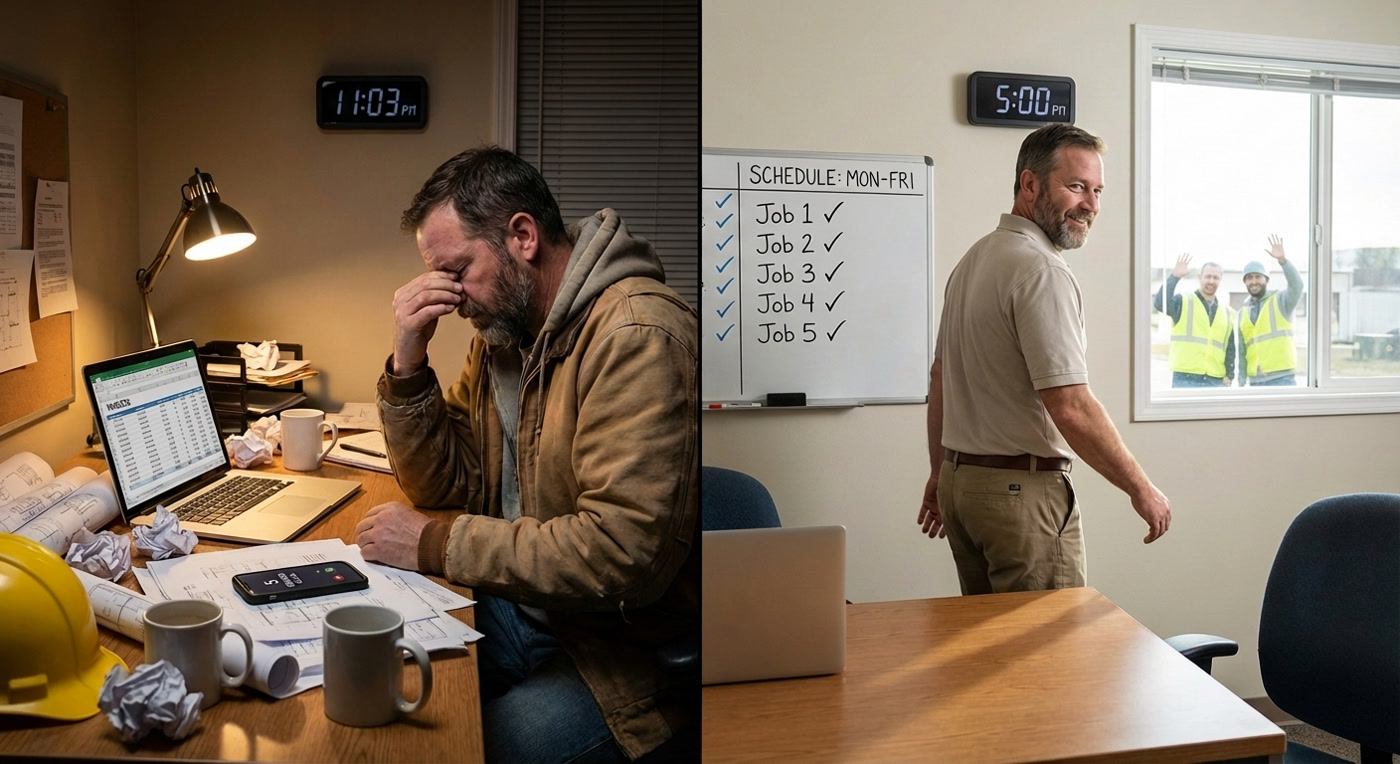
Hard Work Built This Business. It Won't Scale It.
You started this business because you were excellent at the work.
Plumbing, electrical, building, HVAC — whatever your trade, you were good enough that customers started asking for you by name. You hired one person, then three, then eight. Revenue grew. The work kept coming.
And somewhere between 8 and 30 staff, the business stopped being about the work and started being about managing chaos.
Now you're quoting at 9pm. Chasing invoices at 6am. Answering 25 calls a day from your team because nobody else knows enough to decide. Working 55-70 hour weeks. Revenue looks fine on paper but margins feel thin, and you're not entirely sure which jobs actually make money.
You didn't build a bad business. You built a business that outgrew the way it runs.
The skills that got you here — technical excellence, hustle, customer relationships — are genuinely valuable. They're just not the skills that get you to the next stage. And nobody told you that. Nobody teaches tradies how to build the system that runs the business. So you did what every smart operator does: you figured it out yourself, one day at a time, reacting to whatever was loudest.
The result is a business that works. But it works because of you. Not because of any system.
What an Operating System Actually Means
Not software. Not an app. Not a $15K CRM that nobody uses.
An operating system for a trades business is the set of documented, repeatable processes that allow the business to operate without every decision flowing through the owner.
It answers four questions:
How do we win work? Enquiry response. Quoting process. Pricing logic. Follow-up. Conversion tracking. Not in someone's head — in a system anyone can follow.
How do we deliver it? Scheduling. Dispatch. Job handover. Quality standards. Materials management. Communication between field and office. Documented well enough that a new hire can follow it in week two.
How do we get paid? Invoicing triggers. Payment terms. Debtor follow-up. Job costing accuracy. Cash flow visibility. The goal: invoice on completion, chase automatically, know which jobs make money.
How does it run without the owner? Decision rights — who can approve what, up to what value. Management rhythm — daily huddle, weekly review, monthly numbers. Escalation rules — what gets bumped up, what gets handled on the floor.
Most trades businesses have bits of this. A quoting template here. An invoicing process there. But it's patchy, inconsistent, and held together by the owner filling every gap personally.
The businesses that break through — the ones that scale from $2M to $5M to $10M without the owner burning out — are the ones that build the complete system. All four areas. Connected. Documented. Followed.
Why "Just Hire Good People" Doesn't Fix It
Every trades business owner has tried this. Hire someone senior enough to take things off your plate. Give them responsibility. Hope they figure it out.
Sometimes it works — for a while. Then they leave, and everything they carried in their head leaves with them. Or they do things differently to you, and quality drops. Or they're great at the trade but can't manage people, and you end up managing them instead.
Good people don't fix bad systems. They mask them. Until they leave.
The businesses that scale reliably don't depend on finding perfect people. They build systems that make good people great — and make average people competent.
A clear quoting process means your admin doesn't need 15 years of pricing experience. A documented handover checklist means your second-year apprentice delivers the same quality as your senior tech. A daily huddle means problems surface at 7am instead of becoming emergencies at 3pm.
Systems don't replace people. They multiply them.
Process First. Then Technology.
Here's where most trades businesses get the sequence wrong.
They hear "you need systems" and immediately think software. They buy ServiceM8 or SimPRO or Tradify. They spend $5-15K. They set it up (sort of). Nobody uses it properly. Six months later, it's another expensive tool gathering dust.
The problem wasn't the software. The problem was the process underneath didn't exist.
Software is a container. If you pour a messy, undocumented, inconsistent process into ServiceM8, you get a messy, undocumented, inconsistent process — inside ServiceM8. Nothing actually changed.
The sequence that works:
1. Diagnose — find the real bottlenecks. Not the symptoms, the causes.
2. Build the process — document the workflow, decision points, standards, rhythms. On paper. Before any technology.
3. Then connect the tools — configure software to support the process you designed. Not the other way around.
4. Then automate — layer AI and automation onto a solid foundation. This is where the leverage explodes — but only if steps 1-3 are done.
Bolting AI onto broken workflows gives you faster chaos. Bolting AI onto solid processes gives you a business that runs while you sleep. FarFront's Operations Diagnostic is built around this sequence: diagnose the constraint, design the process, then choose the right tools.
What This Looks Like In Practice
Before the operating system: Owner works 60 hours. Quotes take 48 hours. Invoices go out 5-7 days after job completion. Cash flow is tight. New hires take 3 months to be useful. Quality varies by crew. Growth means more hours for the owner.
After the operating system: Owner works 42 hours. Quotes go same-day (admin handles 80%). Invoices trigger on job completion. Cash flow is predictable. New hires follow a structured onboarding — productive in 3 weeks. Quality is consistent because standards are documented. Growth means more capacity, not more chaos.
Same owner. Same trade. Same team (mostly). Different system.
The difference isn't talent or effort. It's architecture.
The Mining Parallel
The disciplines that run a billion-dollar mine site are the same ones that run a great trades business:
- Management Operating System — who does what, when, in what rhythm
- Standard work — documented procedures followed consistently
- Daily huddles — problems surface early, not late
- Visual management — the state of the business is visible at a glance
- Continuous improvement — small fixes compounding over time
BHP doesn't run on the brilliance of individual people. It runs on systems that make thousands of people effective simultaneously.
A 20-person plumbing business doesn't need the complexity. But it needs the same principles. Clear processes. Defined roles. Regular rhythms. Documented standards. Visible performance.
Nobody had translated these for trades. That's what FarFront does through practical operations, automation and reporting solutions for trades businesses.
The Question That Changes Everything
Here it is:
If you took two weeks off tomorrow — completely unreachable — what would break?
Your answer to that question is a map of everywhere your business depends on you instead of a system. Every item on that list is a process that needs to be built, documented, and handed over.
That's not a criticism. It's a diagnostic. And turning that list into a prioritised action plan is the fastest path to a business that works for you instead of the other way around.
Start here
FarFront's Ops Health Check takes 5 minutes and gives you a radar chart across the areas that matter — winning work, delivering it, getting paid, and running without you. No sales pitch. Just an honest picture of where you stand.
Take the Ops Health Check